Science
Alan Mathison Turing
Mathematician and computability theorist
Also known as Alan Turing · A. M. Turing
Photograph · Image credit
Who they are
Alan Turing developed a mathematical account of computation in which an abstract machine follows explicit rules on a symbolic tape. His 1936 paper introduced a universal-machine construction and established limits to general decision procedures. He acknowledged Alonzo Church’s independent formulation, making this a history of converging ideas rather than a solitary invention.
Turing supplies a foundation for the timeline’s computing history: what machines can calculate, and which questions have no general algorithmic solution.
Selected contributions
Selected works
Academic paper · 1936 · Historical journal article; linked transcription includes a later correction
On Computable Numbers, with an Application to the Entscheidungsproblem
Turing gives a machine-based account of calculation and shows that no general procedure solves the decision problem. He also relates his definition to Church’s independently developed account.
1936 paper; the hosted transcription also reproduces Turing’s subsequent correction.
Reading scope & citation
Fresh opening definitions and Church acknowledgment read; prior inspected supporting passages reused. Complete proofs and appended correction not audited.
In the timeline
Biography sources & portrait credit
- On Computable Numbers, with an Application to the Entscheidungsproblem ↗Proceedings of the London Mathematical Society; transcription PDF hosted by University of Oxford
Portrait credit
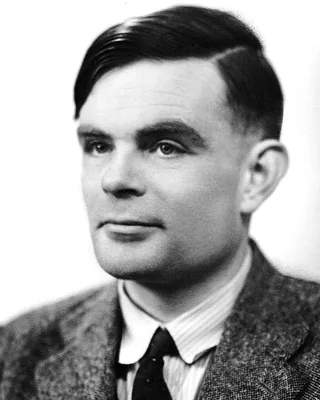
Elliott & Fry. Public domain (Commons file-specific copyright declaration). Via Wikimedia Commons.
Photograph. Cropped to 4:5, resized to 320 × 400 and converted to WebP.
Image source & identification ↗ · Public domain (Commons file-specific copyright declaration) ↗

