Philosophy · Science
Aristotle
Natural philosopher
Also known as Aristoteles · Ἀριστοτέλης
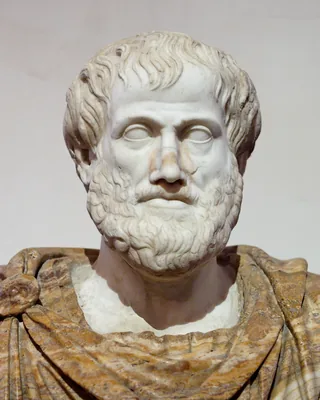
Later depiction · Image credit
Who they are
Aristotle investigated nature through systematic philosophical arguments about bodies, motion and the structure of the cosmos. In On the Heavens he reasoned toward one finite universe and distinguished celestial from terrestrial motion. His inclusion records a powerful historical model of reality, including the assumptions from which it was constructed.
His cosmology provides an early conceptual framework against which later astronomical models can be understood.
Selected contributions
- Presented arguments for a single cosmos in On the Heavens.Source ↗
Selected works
Primary text · 4th century BCE
On the Heavens, Book I
Aristotle argues from his account of natural motion to a single, finite cosmos. Reading the argument shows the conceptual assumptions of an influential ancient cosmology.
Book I in J. L. Stocks’s English translation; original composition date is approximate.
Reading scope & citation
Reused prior inspected evidence: Specified translated primary-text sections and host date metadata inspected, not the complete Aristotelian corpus.
In the timeline
- c. 350 BCEAristotle argues for a single cosmos
Biography sources & portrait credit
- On the Heavens, Book I ↗The Internet Classics Archive, Massachusetts Institute of Technology
Portrait credit
Unknown Roman sculptor after Lysippos; photograph by Jastrow. Public domain (rights-holder dedication). Via Wikimedia Commons.
Later depiction. Cropped to 4:5, resized to 320 × 400 and converted to WebP.
Image source & identification ↗ · Public domain (rights-holder dedication) ↗

