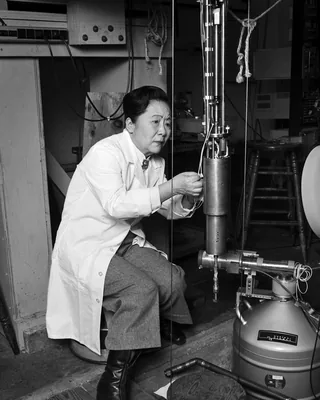
Who they are
Chien-Shiung Wu led the experimental study that tested parity conservation in cobalt-60 beta decay. With Ernest Ambler, Raymond Hayward, Dale Hoppes and Ralph Hudson at the National Bureau of Standards, she reported a directional asymmetry in the emitted electrons. The result answered a theoretical question raised by Tsung-Dao Lee and Chen-Ning Yang.
Her experiment is a clear case of a seemingly fundamental symmetry being tested and found to fail in a particular physical interaction.
Selected contributions
- Led and coauthored the cobalt-60 parity test with the NBS team.Source ↗
Selected works
Academic paper · 1957 · Historical journal article
Experimental Test of Parity Conservation in Beta Decay
Wu, Ambler, Hayward, Hoppes and Hudson report an asymmetry in electrons emitted by polarized cobalt-60 nuclei. The experiment tests parity conservation in a specified weak decay rather than establishing a claim about all physical processes.
Reading scope & citation
Reused prior inspected evidence: Supporting original-paper passages read from publisher PDF; raw counts and statistical analysis not independently reproduced. Publication date checked on article page. Reuses documented prior inspection: Supporting original-paper passages read from publisher PDF; raw counts and statistical analysis not independently reproduced. Publication date checked on article page.
DOI: 10.1103/PhysRev.105.1413
In the timeline
Documented connections
Documented · co authored with
Chien-Shiung Wu and Ernest Ambler co-authored the parity-test report with Raymond Hayward, Dale Hoppes and Ralph Hudson.
This selected pair does not exhaust the five-author collaboration; Lee and Yang’s preceding theoretical proposal is distinct from authorship of this report.
Read the relationship record →Biography sources & portrait credit
- Experimental Test of Parity Conservation in Beta Decay ↗Physical Review 105, 1413–1415, American Physical Society
Portrait credit
Lynn Gilbert. CC BY-SA 4.0. Via Wikimedia Commons.
Photograph. Cropped to 4:5, resized to 320 × 400 and converted to WebP.
