Science
Edwin Powell Hubble
Astronomer measuring galaxy distances and velocities
Also known as Edwin Hubble · Edwin P. Hubble
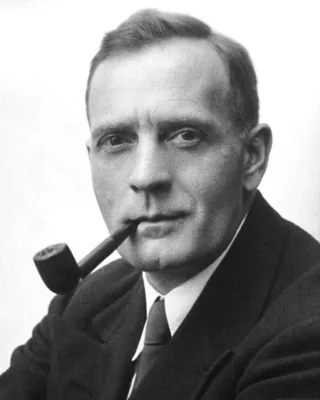
Photograph · Image credit
Who they are
Edwin Hubble used variable stars to estimate distances to spiral nebulae and helped establish that they were systems beyond the Milky Way. He later compared galaxy distances with radial velocities. These studies depended on predecessors’ calibrations, spectral measurements and collaborators’ work, and their early numerical distance scales were provisional.
His linked milestones trace the observed scale of the cosmos and the distance–velocity relation.
Selected contributions
Selected works
Academic paper · 1925
Cepheids in Spiral Nebulae
Hubble uses Cepheid variables and an existing luminosity calibration to place spiral nebulae beyond the Milky Way. The paper records the distance argument, which is distinct from his later velocity–distance study.
Reading scope & citation
Reuses documented prior inspection: Selected original pages visually read as screenshots; the complete plate-measurement reduction was not reconstructed.
Academic paper · 1929
A Relation between Distance and Radial Velocity among Extra-Galactic Nebulae
Hubble compares estimated distances with radial velocities and reports an approximate linear relation for a limited sample. The paper acknowledges antecedent data and numerical assistance; its distance scale was preliminary.
Reading scope & citation
Reuses documented prior inspection: Supporting text and table headings inspected; individual measurements and fitted uncertainties not independently recomputed. Reused prior inspected evidence: Supporting text and table headings inspected; individual measurements and fitted uncertainties not independently recomputed.
In the timeline
Biography sources & portrait credit
- Cepheids in Spiral Nebulae ↗The Observatory 48, 139–142; SAO/NASA Astrophysics Data System scan
- A Relation between Distance and Radial Velocity among Extra-Galactic Nebulae ↗Proceedings of the National Academy of Sciences 15, 168–173; scan hosted by University of Sheffield
Portrait credit
Johan Hagemeyer. Public domain in the United States (Commons file-specific declaration). Via Wikimedia Commons.
Photograph. Cropped to 4:5, resized to 320 × 400 and converted to WebP.
Image source & identification ↗ · Public domain in the United States (Commons file-specific declaration) ↗

