Science · Engineering & invention
Galileo Galilei
Telescopic observer and scientific author
Also known as Galileo
Historical portrait · Image credit
Who they are
Galileo Galilei improved telescopes and used repeated observations to investigate celestial objects. In Sidereus nuncius he described an uneven Moon, many previously unseen stars and bodies orbiting Jupiter. The book records how instrument building and sequential observation could change the evidence available for debates about the heavens.
He represents the transition from inherited astronomical arguments to new instrumental observations.
Selected contributions
- Built improved telescopes and reported the sequence of observations identifying four Jovian satellites.Source ↗
Selected works
Book · 1610
Sidereus nuncius (The Sidereal Messenger)
Galileo reports telescopic observations of the Moon, previously unseen stars and the changing objects near Jupiter. His repeated observations support identifying four Jovian satellites.
Original work 1610; linked Edward Stafford Carlos English translation published in 1880.
Reading scope & citation
Reuses documented prior inspection: Relevant sections of the translated 1610 text inspected. The translator's introduction and appended later writings are distinguished from the 1610 work. Fresh translated title/edition pages, introductory telescope account and Badovere passage read; not all observations or drawings audited.
In the timeline
Biography sources & portrait credit
- The Sidereal Messenger ↗1880 translation, reproduced by Project Gutenberg
Portrait credit
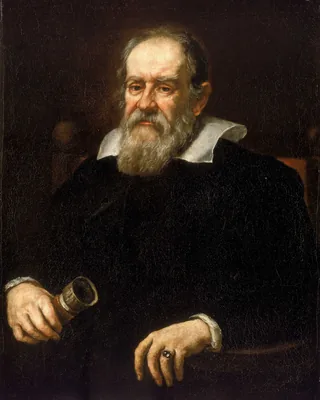
Justus Sustermans. Public domain (Commons file-specific copyright declaration). Via Wikimedia Commons.
Historical portrait. Cropped to 4:5, resized to 320 × 400 and converted to WebP.
Image source & identification ↗ · Public domain (Commons file-specific copyright declaration) ↗