Science · Philosophy
Isaac Newton
Mathematical physicist
Also known as Sir Isaac Newton
Historical portrait · Image credit
Who they are
Isaac Newton used mathematics to connect motion on Earth with motion in the heavens. His Principia set out laws of motion and developed a gravitational account of celestial systems. The work matters here as a major step toward explaining apparently different natural phenomena within a common quantitative framework.
Newton anchors the classical mechanics strand that later developments refine and extend.
Selected contributions
Selected works
Book · 1687
Philosophiae Naturalis Principia Mathematica
Newton sets out laws of motion and a mathematical account of gravitational interactions. The inspected primary passages cover the laws and a gravitational proposition; they are not a complete review of the book’s demonstrations.
Reading scope & citation
Reuses documented prior inspection: Specified Latin primary passages inspected; no independent reproduction of the complete derivations or numerical arguments. Reuses the input’s documented prior inspection: Specified Latin primary passages inspected; no independent reproduction of the complete derivations or numerical arguments. No fresh full-work reread in this directory pass.
In the timeline
Biography sources & portrait credit
- Philosophiae Naturalis Principia Mathematica ↗1687 Latin edition transcribed by Project Gutenberg
Portrait credit
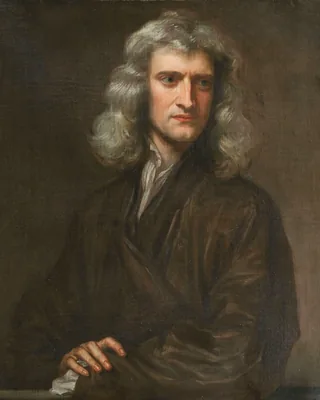
Godfrey Kneller. Public domain (Commons file-specific copyright declaration). Via Wikimedia Commons.
Historical portrait. Cropped to 4:5, resized to 320 × 400 and converted to WebP.
Image source & identification ↗ · Public domain (Commons file-specific copyright declaration) ↗

