Science
Johannes Kepler
Mathematical astronomer
Also known as Joannes Kepler
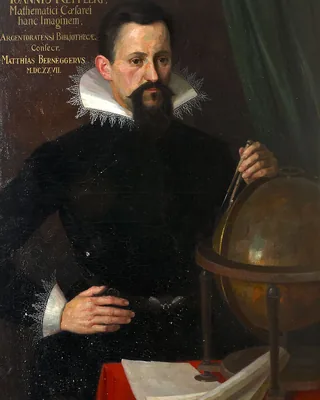
Later depiction · Image credit
Who they are
Johannes Kepler developed a physical and mathematical account of planetary motion using detailed observations, especially those of Mars collected by Tycho Brahe. Astronomia nova, published in 1609, presented the first two laws of planetary motion. His work illustrates how persistent disagreement between a model and measurements can force a change in the model’s geometry.
He connects precise observation with the replacement of circular-orbit assumptions by elliptical motion.
Selected contributions
- Analyzed Brahe’s Mars observations and published Astronomia nova in 1609.Source ↗
- Presented the elliptical-orbit and area-law results associated with the book.Source ↗Source 2 ↗

Selected works
Book · 1609
Astronomia nova aitiologetos, seu physica coelestis
Kepler uses Mars observations to develop an account of planetary motion that includes elliptical orbits and the area law. Brahe’s observational work supplied essential evidence for the analysis.
Reading scope & citation
Reused catalogue metadata, inspected historical account and one original-book diagram with surrounding text; complete Latin work not read.
In the timeline
Biography sources & portrait credit
- Astronomia nova, chapter 59 ellipse diagram ↗1609 edition held and imaged by Linda Hall Library
- Johannes Kepler — Scientist of the Day ↗Linda Hall Library
Portrait credit
August Köhler (1910 portrait). Public domain (Commons file-specific copyright declaration). Via Wikimedia Commons.
Later depiction. Cropped to 4:5, resized to 320 × 400 and converted to WebP.
Image source & identification ↗ · Public domain (Commons file-specific copyright declaration) ↗

