Who they are
Max Planck sought a mathematical account of the spectrum emitted by heated matter. In his 1900 derivation, he counted finite energy elements and compared the resulting law with experimental measurements. The paper is an early quantum milestone, while its reasoning and immediate claims are narrower than the fully developed quantum mechanics that followed.
His radiation calculation anchors the timeline’s transition toward quantum physics.
Selected contributions
Selected works
Academic paper · 1900
On the Theory of the Energy Distribution Law of the Normal Spectrum
Planck calculates the radiation distribution by counting finite energy elements proportional to frequency. The inspected translation shows the connection to measured radiation data, including work by Rubens and Kurlbaum.
English translation of the 1900 paper; translator unidentified in the inspected reproduction.
Reading scope & citation
Reuses documented prior inspection: Selected English translation pages visually read as PDF screenshots; not a full derivation audit or original-language comparison. Reused prior inspected evidence: Selected English translation pages visually read as PDF screenshots; not a full derivation audit or original-language comparison.
In the timeline
Biography sources & portrait credit
- On the Theory of the Energy Distribution Law of the Normal Spectrum ↗Verhandlungen der Deutschen Physikalischen Gesellschaft; English reproduction hosted by Universitat de Barcelona
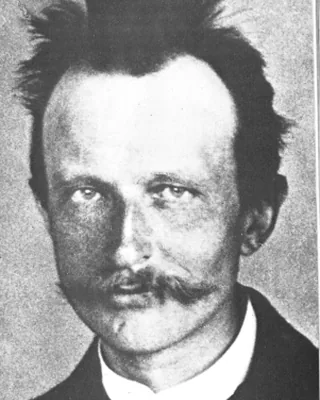
Portrait credit
Unknown photographer. Public domain (Commons file-specific copyright declaration). Via Wikimedia Commons.
Photograph. Cropped to 4:5, resized to 320 × 400 and converted to WebP.
Image source & identification ↗ · Public domain (Commons file-specific copyright declaration) ↗

