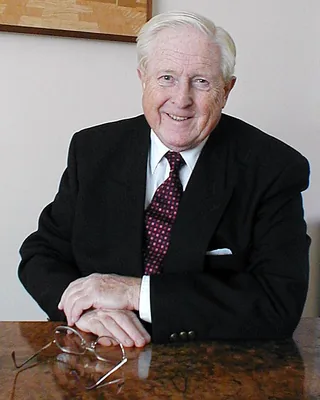
Who they are
Raymond Gosling was an experimental collaborator of Rosalind Franklin in the investigation of DNA by X-ray diffraction. Their joint Nature paper appeared in April 1953 alongside the Watson–Crick structural model and another experimental paper. His profile preserves the contribution of the experimenters whose evidence accompanied the model, without assigning him authorship of Watson and Crick’s paper.
He represents the experimental evidence and collaboration behind the DNA structural milestone.
Selected contributions
- Coauthored Molecular Configuration in Sodium Thymonucleate with Franklin.Source ↗Source 2 ↗
Selected works
Academic paper · 1953 · Published journal article
Molecular configuration in sodium thymonucleate
Franklin and Gosling’s experimental DNA paper appeared alongside the Watson–Crick model in Nature. It offers a route into the X-ray evidence underlying the structural debate; this summary uses the verified catalogue and King’s historical account.
Reading scope & citation
Indexed PubMed record: R. E. Franklin and R. G. Gosling, Nature 171(4356), 740–741, DOI 10.1038/171740a0. Full indexed bibliographic text retrieved through search; direct PubMed extraction exposed only a footer and Nature redirected to an inaccessible identity service. No abstract is supplied in PubMed. Content context is from the prior inspected King’s account.
DOI: 10.1038/171740a0
In the timeline
Documented connections
Documented · co authored with
Rosalind Franklin and Raymond Gosling co-authored one of the two experimental papers accompanying the DNA model.
Authorship is checked against King’s custodial account; their original experimental paper was not inspected in full.
Read the relationship record →Biography sources & portrait credit
- King’s and DNA ↗King’s College London
- Molecular configuration in sodium thymonucleate ↗Nature; PubMed bibliographic record
Portrait credit
Mrs. Gosling; source crop by David Ruben. CC BY-SA 3.0. Via Wikimedia Commons.
Photograph. Cropped to 4:5, resized to 320 × 400 and converted to WebP.
